
Amazon FBA Packaging Fees in 2026: SIPP Eligibility and Costs
Amazon introduced packaging fee changes for certain bulky and oversize FBA products in 2026. This guide explains the differences between the US and European rules, how Ships in Product Packaging (SIPP) works, and how sellers can check ASIN eligibility, prepare packaging, complete testing, and enroll products. It also includes a sample cost calculation and explains how Label Resizer can simplify PDF product and shipping label preparation. Sellers will learn how to evaluate potential savings using Amazon’s current fee information rather than relying on general estimates.

Amazon FBA packaging fees changed in 2026. In the United States, Amazon introduced a packaging fee for certain Small Bulky and Large Bulky products that are not eligible for Ships in Product Packaging (SIPP), or are not enrolled and require additional packaging. In the European Union, new fees for oversize products began on February 1, 2026.
The rules and amounts depend on the marketplace and the product’s classification, so there is no single fee that applies to every ASIN. The practical response is to review affected products, check whether their packaging can qualify for SIPP, and compare the cost of compliance with the fees in Amazon’s current rate card.
What changed with Amazon FBA packaging fees in 2026?
Amazon’s 2026 US fee announcement split the former Large Bulky tier into Small Bulky and Large Bulky tiers, adjusted fulfillment fees for bulky products, and introduced a packaging fee for Small Bulky and Large Bulky products that are not eligible for SIPP. Amazon states that this fee averages $2.07 per unit. It is an average, not a flat charge for every ASIN.
According to Amazon, the fee reflects the cost of packaging a product that cannot ship in its own packaging. The same announcement says fulfillment fees were reduced by an average of $2.06 per unit for Small Bulky products and $0.26 per unit for Large Bulky products.
In Europe, Amazon’s SIPP FAQ says new packaging fees took effect for oversize products on February 1, 2026. They apply to items that are not enrolled in SIPP and require additional packaging. Certain ineligible items, including dangerous goods and size-restricted products, are exempt from these charges in the EU.
Start with Amazon’s own pages before making a pricing decision:
- 2026 US FBA fee announcement
- Amazon SIPP program and packaging-fee FAQs
- Amazon Europe SIPP information
What is Ships in Product Packaging (SIPP)?
Ships in Product Packaging, or SIPP, is Amazon’s program for products that can be delivered to customers in their own packaging without Amazon adding another box, bag, or envelope. The program was previously known as Ships in Own Container (SIOC); Amazon says the certification standards remain the same.
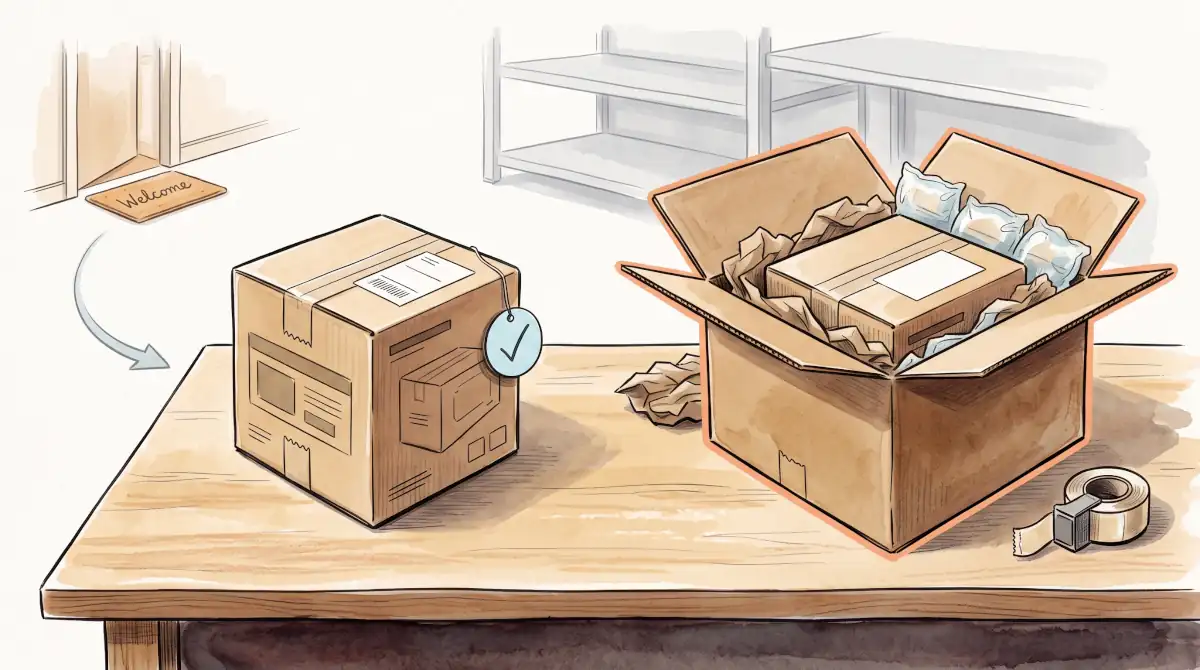
For sellers, qualifying packaging may mean lower fulfillment costs or avoiding applicable packaging fees, depending on the marketplace and product type. Customers may see a message at checkout that the product ships in its own packaging. They can still add Amazon packaging at no additional cost, and Amazon says certified products keep their program benefits in that case.
SIPP is not something a seller can simply add to a listing. The packaging must meet Amazon’s requirements, pass testing, and be enrolled through the program. Some products may already have been identified and certified by Amazon, so check the program portal before starting a new certification effort.
Enrolling in SIPP is free. Redesigning packaging, producing it, or paying for laboratory testing may not be, so weigh those costs against the potential savings.
Which products and marketplaces are affected?
The 2026 US announcement covers Small Bulky and Large Bulky products. The EU change applies to oversize products. Do not apply US size tiers or fee figures directly to an EU listing.
Amazon’s program is open to eligible FBA sellers in the US, Canada, France, Italy, Germany, Spain, and the UK, but each ASIN still needs to meet the requirements. Use Seller Central’s SIPP enrollment portal to search for eligible ASINs. If a product is not eligible, check the stated reason and evaluate the available packaging or fulfillment options.
For each product you review, note:
- Marketplace and fulfillment program.
- ASIN and current product size tier.
- Current packaging type and dimensions.
- SIPP eligibility and certification status.
- Whether Amazon’s fee page indicates that additional packaging is required.
- The current fulfillment and packaging fees for that marketplace.
How to reduce the risk of additional packaging fees
1. Review your catalog before changing packaging
Identify products that may fall into the relevant bulky or oversize tiers using the dimensions and weight Amazon has on file. If Amazon’s dimensions are wrong, request a remeasurement through Seller Central rather than changing packaging based on an assumption.
Then check each candidate ASIN in the SIPP portal. Some products may already be certified without a separate enrollment request, so confirm the status before spending money on redesign or testing.
2. Design packaging for the product and the journey
Amazon’s SIPP guidance covers flexible packaging, such as bags and mailers, and rigid packaging, such as six-sided boxes. The packaging must meet the specifications and protect the product through the fulfillment network. A box that looks sturdy on a shelf is not automatically compliant.
Check the current guidelines for material, dimensions, closure, and product-to-package fit. Avoid unnecessary empty space, but do not reduce protection just to make a package smaller; damage leads to returns and potential certification issues.
3. Group similar products where the rules allow it
Amazon allows sellers to group certain similar products for certification based on factors such as size, weight, packaging material and type, product-to-package ratio, and quantity. When a group is permitted, you may be able to test only the largest or heaviest product instead of every variation. Products sharing a brand or listing family do not automatically qualify; check Amazon’s product-grouping guidance.
4. Complete the required packaging test
Packaging must pass physical performance testing. Depending on the product, you may be able to self-test or may need a qualifying ISTA 6 laboratory report. Amazon’s guidance says fragile products and products containing liquids or sharp items require lab testing.
Follow the current test instructions for your packaging type. For self-testing, Amazon asks sellers to photograph the packaging and product before and after the test. An informal drop from a convenient height is not proof of compliance.
5. Enroll the product and enter the right date
After testing, submit the ASIN or product group through the SIPP enrollment portal with the requested details and test documentation, then enter the first arrival date for compliant inventory at an Amazon fulfillment center.
This date matters. Amazon says SIPP benefits apply to units received after this date once the request is approved, and the date cannot be changed after entry. Wait until you can provide an accurate date rather than guessing.
Keep a record of the submitted ASINs, the tested packaging version, the date entered, and the approval status. If the packaging changes materially later, check whether the certification still applies.
How to assess whether SIPP is worth it for your product
The decision is a comparison: the cost of making packaging compliant (materials, redesign, testing, operational changes) against the fees and fulfillment benefits that apply to that specific ASIN.
Here is a simple example. The figures below are hypothetical and are not Amazon’s actual rates.
- A product sells 300 units per month and is charged a packaging fee of $2.00 per unit: $600 per month.
- Compliant packaging costs $0.40 more per unit than the current packaging: $120 per month.
- Redesign and lab testing cost $1,500 once.
- Net monthly benefit: $600 − $120 = $480. The one-time cost is recovered in a little over three months.
The same product selling 30 units per month would save only $48 per month, taking more than two and a half years to recover the $1,500. For slow-moving products, the effort may not pay off.
Use your own numbers from Amazon’s Revenue Calculator, Fee and Economics Preview reports, or other current Seller Central fee tools. Do not base the calculation on the $2.07 US average alone, and European sellers should use the rate card for their own marketplace.
Where Label Resizer fits into your FBA prep workflow
SIPP certification determines whether eligible products can ship in their own packaging. You still need to prepare your inbound labels according to Amazon’s requirements: Amazon’s SIPP FAQ says each unit sent to a fulfillment center must have an exterior scannable label.
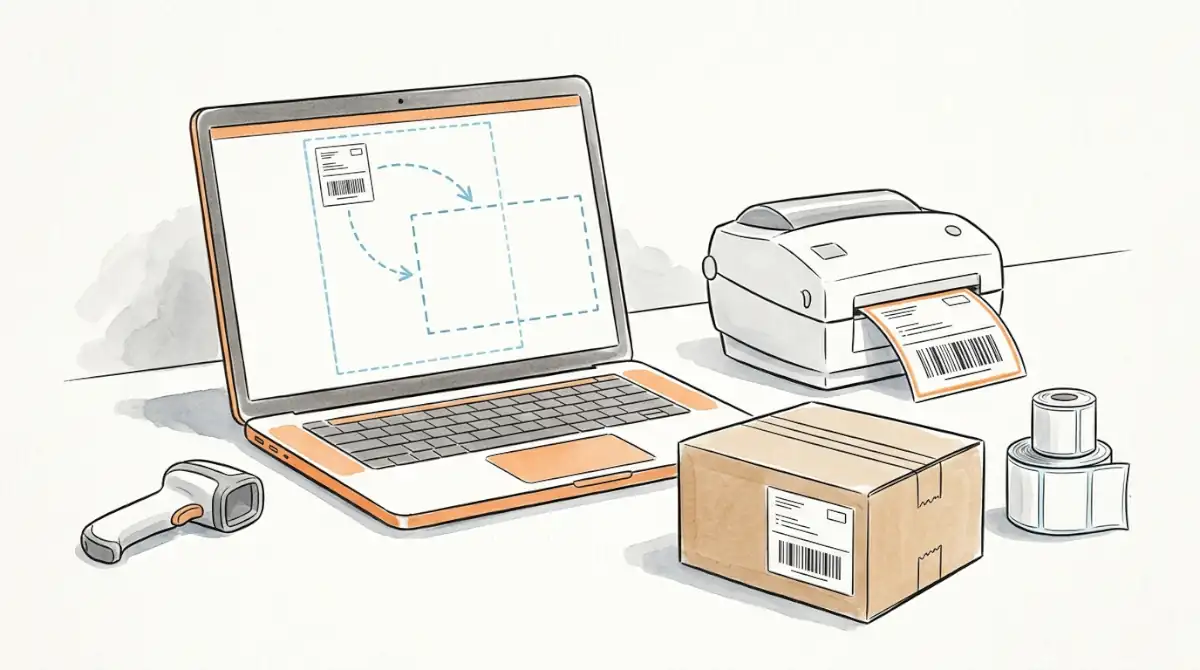
If your FBA product labels or shipment labels arrive as PDFs that don’t match your printer or label stock, Label Resizer helps you adjust PDF label dimensions before printing. This makes routine label preparation easier, especially when you work with different label formats.
Resize your labels, review the output, and check that barcodes and required information remain clear before printing. Label Resizer handles PDF label preparation; it does not certify packaging, enroll ASINs in SIPP, or guarantee exemption from Amazon’s packaging fees.
Learn more about Label Resizer.