
Amazon Cosmetics Barcode Requirements: The Complete FNSKU Compliance Guide
Amazon requires FNSKU labels on every cosmetics unit sent to FBA, since manufacturer barcode tracking is not allowed for this category. This guide explains UPC requirements, FNSKU printing, barcode placement rules, GTIN exemptions, and hazmat SDS documentation sellers need before shipping.

Many cosmetics sellers assume they can use the same barcode setup they used for other product categories. However, they often don’t realize that cosmetics follow different Amazon requirements until preparing their first FBA shipment. The rule is simple but easy to overlook: cosmetics and topical products cannot use manufacturer barcode tracking, even if you own the brand. Every single unit needs an Amazon barcode, known as an FNSKU.
This isn’t a minor technicality. Get it wrong and you’re looking at rejected shipments, delayed inventory, or in worse cases, account health warnings that follow you into future ASIN launches. If you sell foundations, serums, shampoos, or perfumes through FBA, this guide walks through exactly what Amazon expects, why the rule exists, and how to stay compliant without slowing down your operations.
Why Cosmetics Have Special FBA Rules
Amazon treats cosmetics differently because of what these products actually are: things people apply to their skin, hair, or body. If a counterfeit or mislabeled unit ends up in a customer’s hands, the consequences aren’t just a bad review. They can be a genuine safety issue.
As a result, cosmetics and topical products aren’t eligible for manufacturer barcode inventory tracking, which means their inventory cannot be commingled with units from other sellers. Commingled inventory is the system where Amazon pools units from different sellers based on a shared manufacturer barcode (the UPC or EAN printed on the product), rather than tracking each seller’s inventory separately. While this works well for many product categories, using an FNSKU allows Amazon to trace each unit back to the seller who supplied it instead of relying on a shared manufacturer barcode.
The rule applies broadly across the category. Products commonly affected include:
- Foundations, concealers, sunscreens and eyeshadow palettes
- Lipsticks, lip balms, and other lip products
- Skin creams, serums, and moisturizers
- Shampoos, conditioners, and hair treatments
- Perfumes, colognes, and body sprays
If your product is a cosmetic or topical product applied to the skin, hair, lips, or body—or is a fragrance or spray intended for personal use—you should assume this rule applies unless Amazon’s category guidelines state otherwise.
Do Cosmetics Need a UPC?
Yes. To create a product listing in the first place, you need a valid UPC (or another GTIN format) issued through GS1, the organization that manages global barcode standards. Amazon may check the UPC you submit against the GS1 database to verify that it’s registered to your brand or company.
This is where a lot of sellers get caught off guard. Barcodes purchased from third-party resellers, rather than directly through GS1, often aren’t properly registered in GS1’s database under your company name. Amazon has become more consistent in verifying barcode ownership, and a mismatch can result in the listing being flagged, suppressed, or removed, sometimes with little warning.
If you’re setting up new cosmetics listings, purchase your UPCs directly from GS1 and register your products correctly. It costs more upfront than buying barcodes from a reseller, but it eliminates a compliance risk that could otherwise surface months after you’ve already invested in photography, copywriting, and inventory.
Can Cosmetics Use Manufacturer Barcodes?
No, not for FBA inventory tracking. Having a valid UPC on your product packaging is necessary for creating the listing, but it doesn’t mean Amazon will track your FBA inventory using that barcode.
For many eligible product categories, sellers can choose “Manufacturer Barcode” as their labeling preference in Seller Central, which enables commingled inventory. Cosmetics and topical products aren’t eligible for this option. Even if you’re enrolled in Amazon Brand Registry, have a registered trademark, and use GS1-issued UPCs, Amazon still requires an Amazon barcode (FNSKU) on every unit. The rule is based on the product category, not your brand or seller status.
When Do You Need an FNSKU?
You need an FNSKU on every single cosmetics unit you send into an Amazon fulfillment center. There’s no threshold or exception based on order volume, shipment size, or how established your listing is. If it’s going into FBA, it needs the Amazon barcode applied before it leaves your facility or prep center.
FNSKU vs UPC: What’s the Difference?
These two barcodes look similar but serve completely different purposes, and mixing them up is one of the most common causes of shipment problems.
The UPC is the retail barcode tied to your product listing. It identifies the product itself, globally, regardless of who’s selling it. You submit this when creating your listing on Amazon, and it’s usually the barcode already printed on your packaging from manufacturing.
The FNSKU is Amazon’s internal tracking barcode. It identifies inventory as belonging to your seller account within Amazon’s fulfillment network. It’s generated inside Seller Central and has to be printed and applied separately, on top of or alongside your existing UPC.
For many eligible product categories, sellers can choose whether to rely on the UPC alone (commingled) or add an FNSKU (stickered, separately tracked). For cosmetics, that option isn’t available. The FNSKU isn’t optional; it’s the only labeling method Amazon accepts for this category.
How to Print Amazon FNSKU Labels Correctly
FNSKU labels are generated through the “Print Item Labels” step in the Send to Amazon workflow inside Seller Central. Once you convert an ASIN to Fulfilled by Amazon and add it to a shipment plan, Amazon generates the FNSKU label for your inventory and lets you download it as a PDF, ready to print.
Amazon expects labels to be printed clearly, at the correct size, and with enough contrast for warehouse scanners to read them on the first pass. A blurry, smudged, or incorrectly scaled label can cause a scanner rejection at receiving, which may delay your shipment or cause the unit to be set aside for manual review—both of which cost time.
Printer choice and label size also matter. Thermal printers using standard label stock (commonly 1” × 2.625”, although Amazon supports multiple label formats) tend to produce more reliable results than inkjet printers using adhesive sheets cut by hand. If you’re managing FNSKU printing across dozens or hundreds of SKUs, doing this manually quickly becomes a bottleneck — Label Resizer is built to handle exactly this by generating, resizing, and formatting FNSKU labels consistently, so you spend less time troubleshooting scanner issues later.
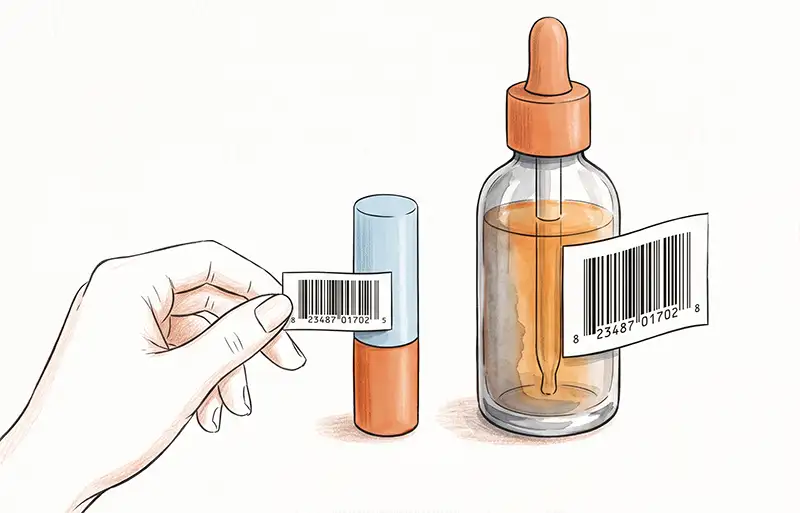
Depending on your workflow, you may need to print on thermal labels, Avery® label sheets, or a custom label size that better fits your packaging. Instead of manually resizing Amazon’s PDFs each time, Label Resizer supports a wide range of thermal printer formats, popular Avery templates, and virtually any custom label dimensions with its resizing feature.
Many cosmetics sellers also need to include additional information such as expiration dates, lot numbers, batch codes, country of origin, or internal SKU references. With Label Resizer’s Free Text on Product Labels feature, you can add custom text directly to your labels without applying separate stickers. And if you need more than just an FNSKU, the Label Editor lets you create fully customized product labels by combining logos, images, text, and barcodes into a single printable layout.
Whatever tool you use, always verify the label preview against the actual product dimensions before printing a full batch. A label sized correctly for a 100 ml bottle won’t necessarily fit a small lipstick tube, and many labeling issues start with incorrect sizing or placement rather than the print quality itself.
Barcode Placement Requirements
Where you physically place the FNSKU matters as much as printing it correctly. Amazon’s fulfillment centers scan units quickly, often with automated or semi-automated equipment, and a poorly placed barcode can slow the receiving process or prevent the barcode from being scanned correctly.
A few placement rules come up repeatedly across cosmetics shipments:
- Place labels on a smooth, visible area. Avoid placing barcodes over seams, edges, corners, or curved surfaces where they may wrinkle or become difficult to scan.
- Poly-bagged products. If your product ships inside a transparent poly bag, the barcode must be scannable through the bag. If it isn’t clearly visible through the packaging, apply the FNSKU to the outside of the bag instead.
- Bundled or multi-unit sets. When you’re selling a bundle, only the bundle’s FNSKU should be visible and scannable. Cover any visible UPCs or other scannable barcodes on the individual products so warehouse associates don’t accidentally scan the wrong barcode.
- Bubble wrap or protective packaging. If a unit is wrapped for protection, the FNSKU must remain visible and scannable from the outside. Tape, labels, or protective materials shouldn’t cover or obstruct the barcode.
None of these requirements may seem like a big deal on their own, but at scale, even a small percentage of mislabeled units can lead to receiving delays, relabeling costs, inventory discrepancies, or units becoming temporarily unavailable while the issue is resolved.
GTIN Exemption Explained
If you manufacture your own private-label cosmetics and don’t have a traditional manufacturer barcode to begin with, you may be eligible for a GTIN exemption. This lets you list products without a UPC, using Amazon’s internal identifier instead.
You can request a GTIN exemption through Seller Central, and the process is largely self-service. It’s generally intended for private-label sellers, manufacturers, or brand owners who don’t have GS1-issued GTINs for their products.
It’s worth noting that a GTIN exemption solves your listing problem, not your FBA labeling problem. You’ll still need an FNSKU on every unit for fulfillment center tracking, exactly as described earlier in this guide. The exemption only affects whether you need a UPC to create the listing itself.
Hazmat Requirements for Beauty Products
Barcode compliance is only part of the picture for many cosmetics sellers. A significant number of beauty products qualify as dangerous goods (hazmat) because of ingredients such as alcohol, flammable solvents, or aerosol propellants.
Products that seem completely ordinary to most sellers often fall into this category, including nail polish, hairspray, and some perfumes. Amazon may require a Safety Data Sheet (SDS) or additional dangerous goods (hazmat) review before allowing an ASIN to be fulfilled through FBA. If you haven’t prepared this documentation ahead of time, it can delay your shipment just as you’re ready to send inventory to a fulfillment center.
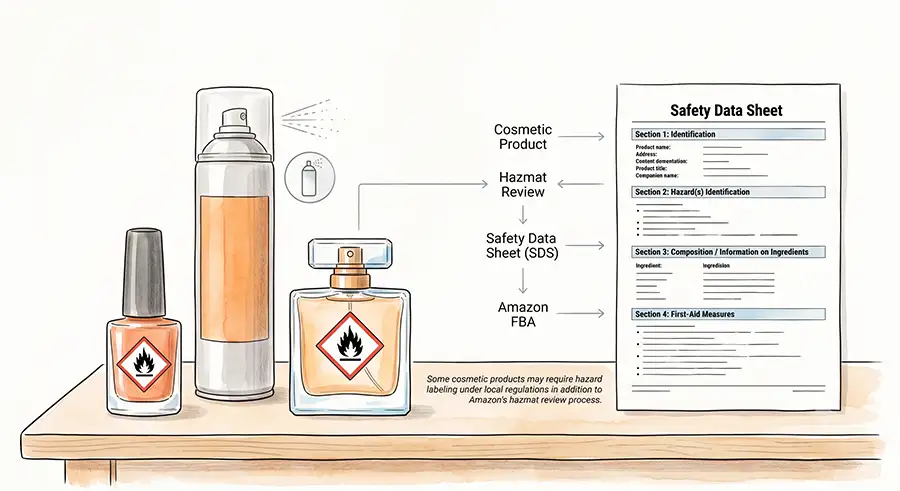
The easiest way to avoid delays is to check your product’s hazmat classification early. Verify the classification during your initial product setup, alongside obtaining your UPC and generating your FNSKU, so you’re not scrambling for documentation while your inventory sits in limbo.
Some cosmetic products also require warning labels depending on the ingredients or destination marketplace. Instead of designing these separately, Label Resizer can generate warning labels alongside your other Amazon labels from the same workflow.
Common Mistakes Sellers Make
Most compliance issues with cosmetics barcoding come down to a handful of repeated mistakes rather than obscure edge cases. Watching out for these can save you time, money, and unnecessary shipment delays:
- Assuming Brand Registry removes the FNSKU requirement. It doesn’t — Brand Registry unlocks other benefits, but it doesn’t change Amazon’s labeling requirements for cosmetics.
- Buying UPCs from third-party resellers instead of directly from GS1. This creates a mismatch risk that can surface long after the listing goes live.
- Applying barcodes to curved packaging or poly bags without ensuring they’re clearly scannable. This is one of the most common causes of receiving delays at fulfillment centers.
- Leaving individual unit barcodes visible on bundles. Warehouse scanners can pick up the wrong barcode, creating inventory confusion.
- Treating SDS documentation as an afterthought. Waiting until shipment creation to check hazmat status is one of the most avoidable causes of shipment delays.
- Applying for a GTIN exemption when you’re not eligible. GTIN exemptions are intended for qualifying products without GS1-issued GTINs, and misuse can lead to listing issues later.
Simplifying Cosmetic Label Printing
Whether you’re preparing your first shipment or managing hundreds of cosmetic SKUs, printing labels quickly becomes more than simply generating an FNSKU. Many sellers also need product labels, warning labels, expiration dates, lot numbers, logos, and different print layouts depending on the packaging.
Instead of switching between multiple design tools and PDFs, Label Resizer brings these tasks together in one workflow. You can:
- Generate Amazon FNSKU labels
- Print on thermal printers or Avery® label sheets
- Add free text such as expiration dates, lot numbers, batch codes, or internal SKU references
- Create custom product labels with logos, images, text, and barcodes using the Label Editor
- Generate warning labels for cosmetic products
- Resize labels to better fit small cosmetic packaging
This helps reduce manual work while keeping your labels consistent across every shipment.
Conclusion
Selling cosmetics through Amazon FBA means following stricter barcode and inventory tracking rules than many other product categories. While you still need a GS1-issued UPC (or a GTIN exemption, if you qualify) to create your listing, every FBA unit must ultimately carry an Amazon FNSKU for fulfillment.
Getting these requirements right from the beginning helps you avoid shipment delays, listing issues, and unnecessary relabeling costs later. Investing in a reliable labeling workflow — and the right tools — can save hours of manual work while helping your shipments arrive at Amazon ready to receive.